Best Token Scanners in 2026 (7 Tools Compared)
Which token scanner should you use? Compare 7 tools on chains, pricing, features, and output formats. See what each does best.
Every blockchain launches tokens daily. Most fail silently. A few rug. The difference is detection speed and the signals you check before deploying capital or launching a campaign.
This guide cuts through the scanner landscape. We tested and verified the 7 most-used token scanners across on-chain security, liquidity tracking, tokenomics, community data, and developer activity. We then checked what each tool actually does, which chains it covers, and who should use it.
Token Health Scan is in this roundup. We'll be direct about where we win and where competitors outperform us.
What is a Token Scanner?
A token scanner is a tool that ingests a token's contract code, on-chain data, and social signals, then surfaces a trust verdict in seconds. Most scanners answer one question: "Is this token safe?" or "Is it a scam?"
Some scanners go deeper. They ask: "Is the liquidity real? Are the founders locked in? What's the developer history?" The breadth of signals you check determines the depth of due diligence you can do.
Who Needs Which Scanner?
Protocol founders need a full health report before campaign launches or before a price decline becomes a crisis. One-dimension scans (security-only) leave blind spots. You need liquidity, holder concentration, and community signals all at once.
Token investors want a fast red/green signal before sizing a position. A security check (honeypot detector) is usually enough. If a token passes honeypot checks, you can move to manual due diligence.
Growth operators preparing quarterly reports need a baseline score they can track across time. One-off snapshots don't work. You need a tool that returns the same dimensions every scan.
AI agent developers integrating token risk checks into agentic commerce or wallet platforms need a single API call that returns a composite verdict plus explainability. Chaining 3 APIs (one for security, one for liquidity, one for tokenomics) creates latency and requires you to synthesize the result yourself.
Master Comparison: 7 Scanners + Token Health Scan
Every scanner here checks contract security. That is table stakes. What separates them is everything *else* they check, which is where the real differences show up.
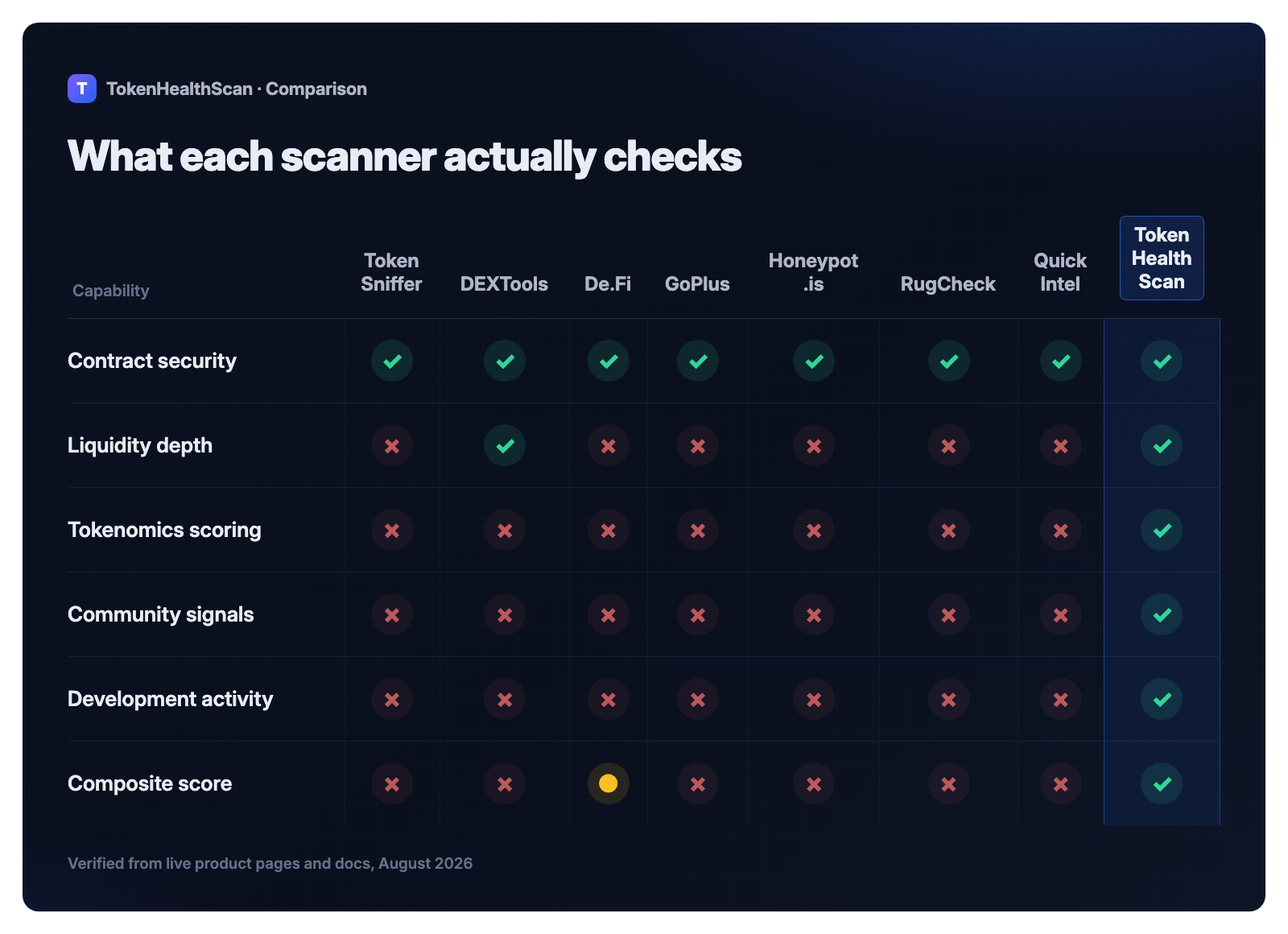
Scope, chains and pricing
| Scanner | Core scope | Chains | Free tier | Cheapest paid |
|---|---|---|---|---|
| Token Sniffer | Security and scam detection | 15 (EVM + Solana) | Unlimited web | $99/mo (API) |
| DEXTools | Trading terminal, light audit signal | Multi (ETH, BSC, Polygon, Base, Solana, Monad observed) | Yes | $100/mo in DEXT |
| De.Fi | Security + wallet approvals | ~40–45 (Shield); 8 EVM (Scanner) | Yes (core tools) | Not published |
| GoPlus | Security detection, broad coverage | 40+ plus Solana and Sui | Console + 150K CU API | $199/mo (API) |
| Honeypot.is | Honeypot detection only | 3 (ETH, BSC, Base) | Yes, no auth | Not yet available |
| RugCheck | Rug risk, Solana-native | Solana + Fogo | Yes, 3 req/sec | $40/mo (API) |
| Quick Intel | Security, scam and sniper detection | 30+ | Yes, no sign-in | $4.99/mo |
| Token Health Scan | 5-dimension composite health | 5 (ETH, Base, Arbitrum, Solana, Polygon) | 3 lifetime scans | $20/mo |
Quick Intel is the cheapest paid tier in this set. GoPlus and De.Fi cover far more chains than we do. Those are real advantages and worth weighing.
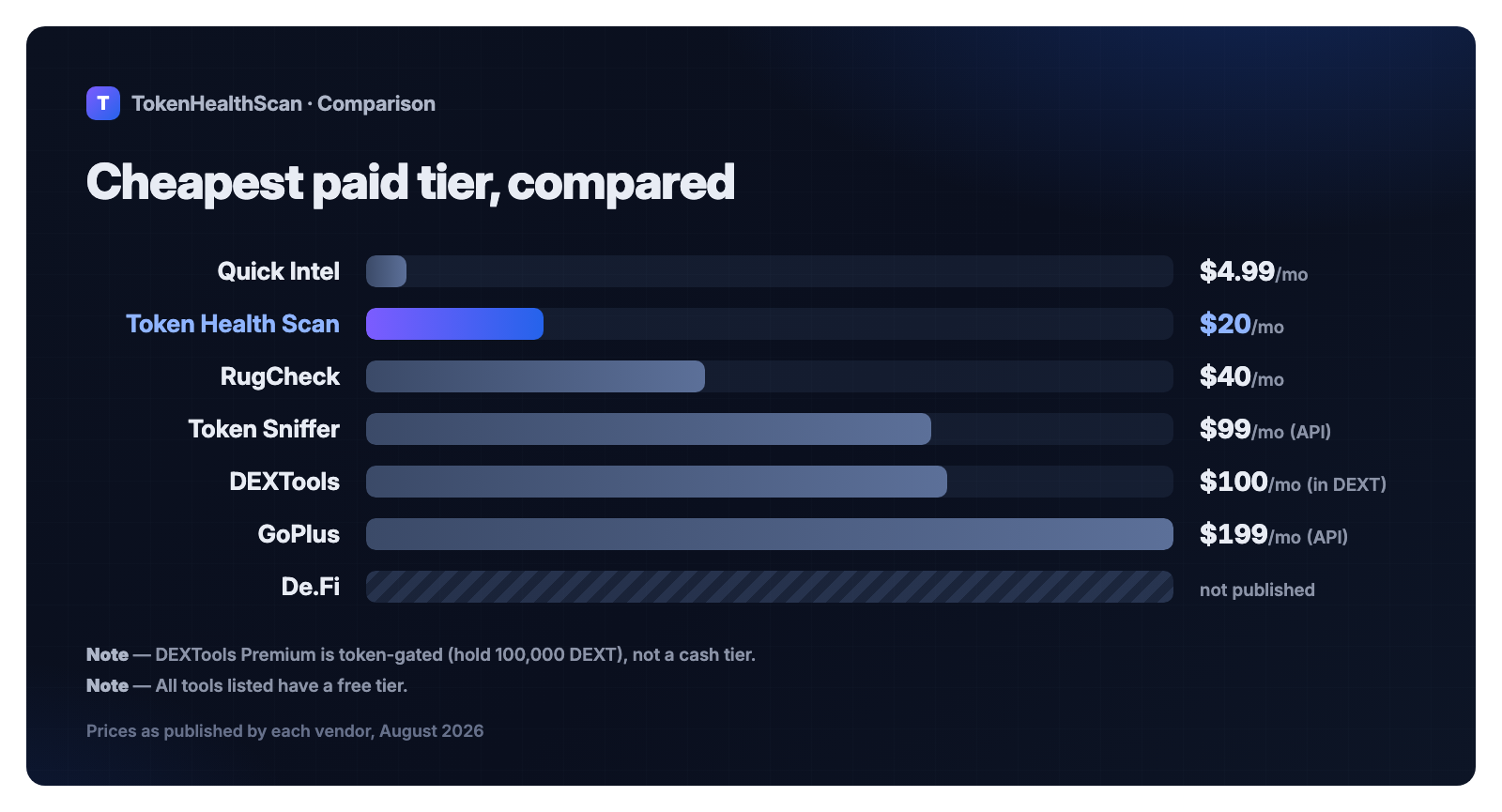
What each tool scores beyond security
| Scanner | Liquidity | Tokenomics | Community | Dev activity | Composite | Fix list |
|---|---|---|---|---|---|---|
| Token Sniffer | – | – | – | – | – | – |
| DEXTools | Yes | – | – | – | – | – |
| De.Fi | – | – | – | – | Partial | – |
| GoPlus | – | – | – | – | – | – |
| Honeypot.is | – | – | – | – | – | – |
| RugCheck | – | – | – | – | – | – |
| Quick Intel | – | – | – | – | – | – |
| Token Health Scan | Yes | Yes | Yes | Yes | Yes | Yes |
*Sources: all data verified from live product pages, docs, and pricing tables as of 2026-08-06. De.Fi Scanner data sourced from company blog (2023) and third-party review (Jul 30, 2026) due to site blocking automated scraping.*
What the output actually looks like
A composite score is only useful if you can see what drives it. Here is a live Token Health Scan report: the composite up top, then the five dimensions scored independently.
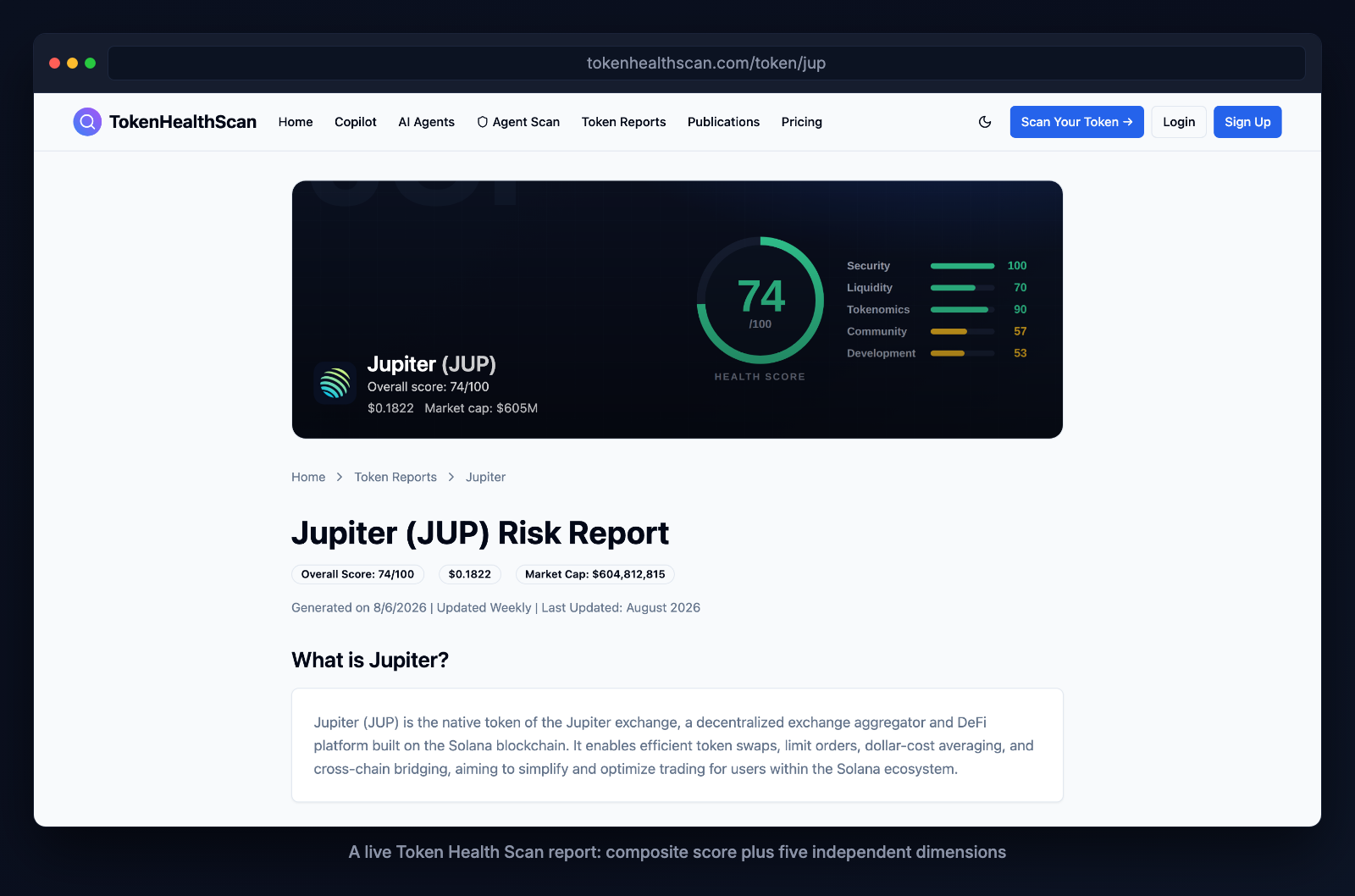
Scroll further and each dimension expands into its own scored card with a plain-English rating.
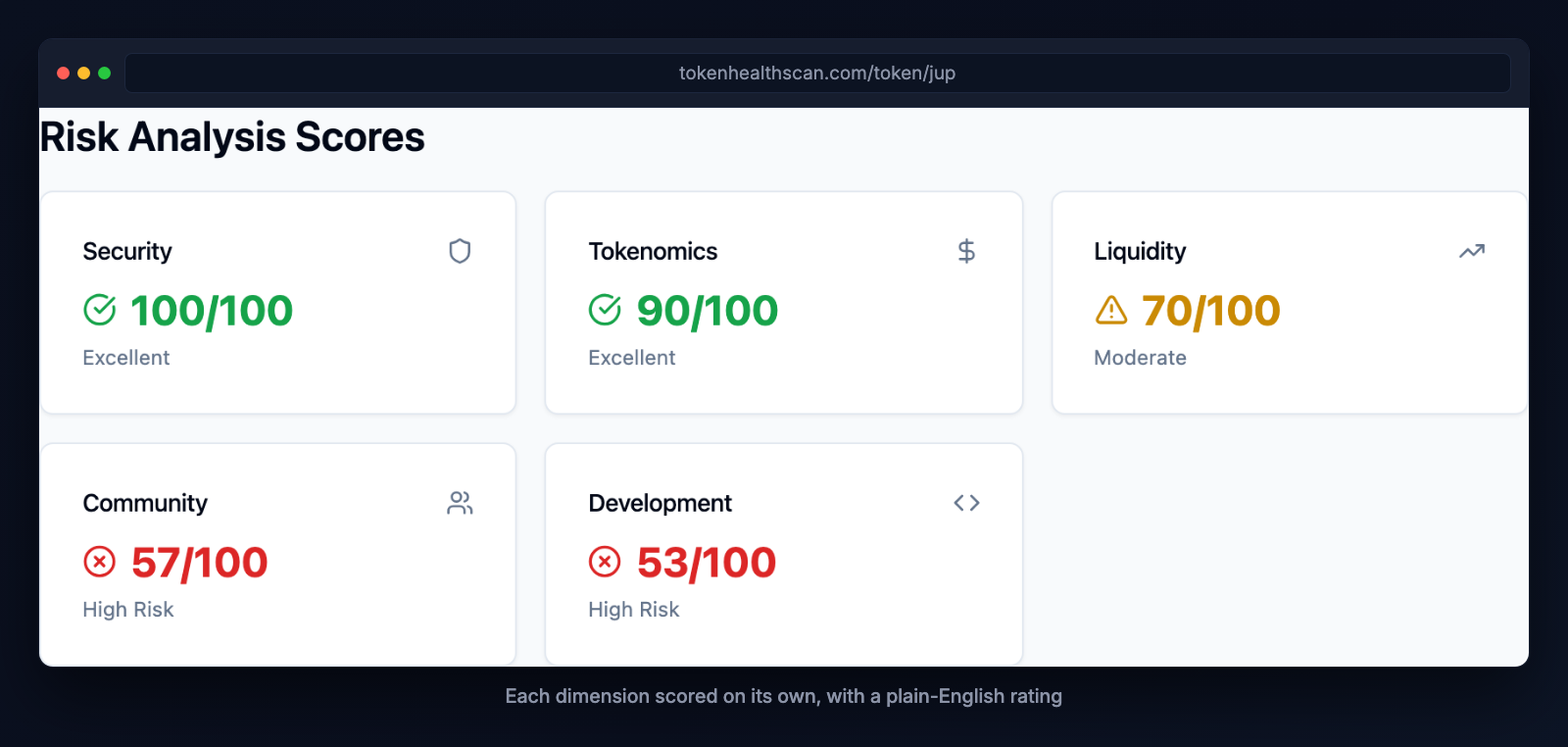
The spread matters more than the headline number. A token can hold a perfect security score while development activity sits near the bottom, and a security-only scanner would show you the first signal and none of the second.
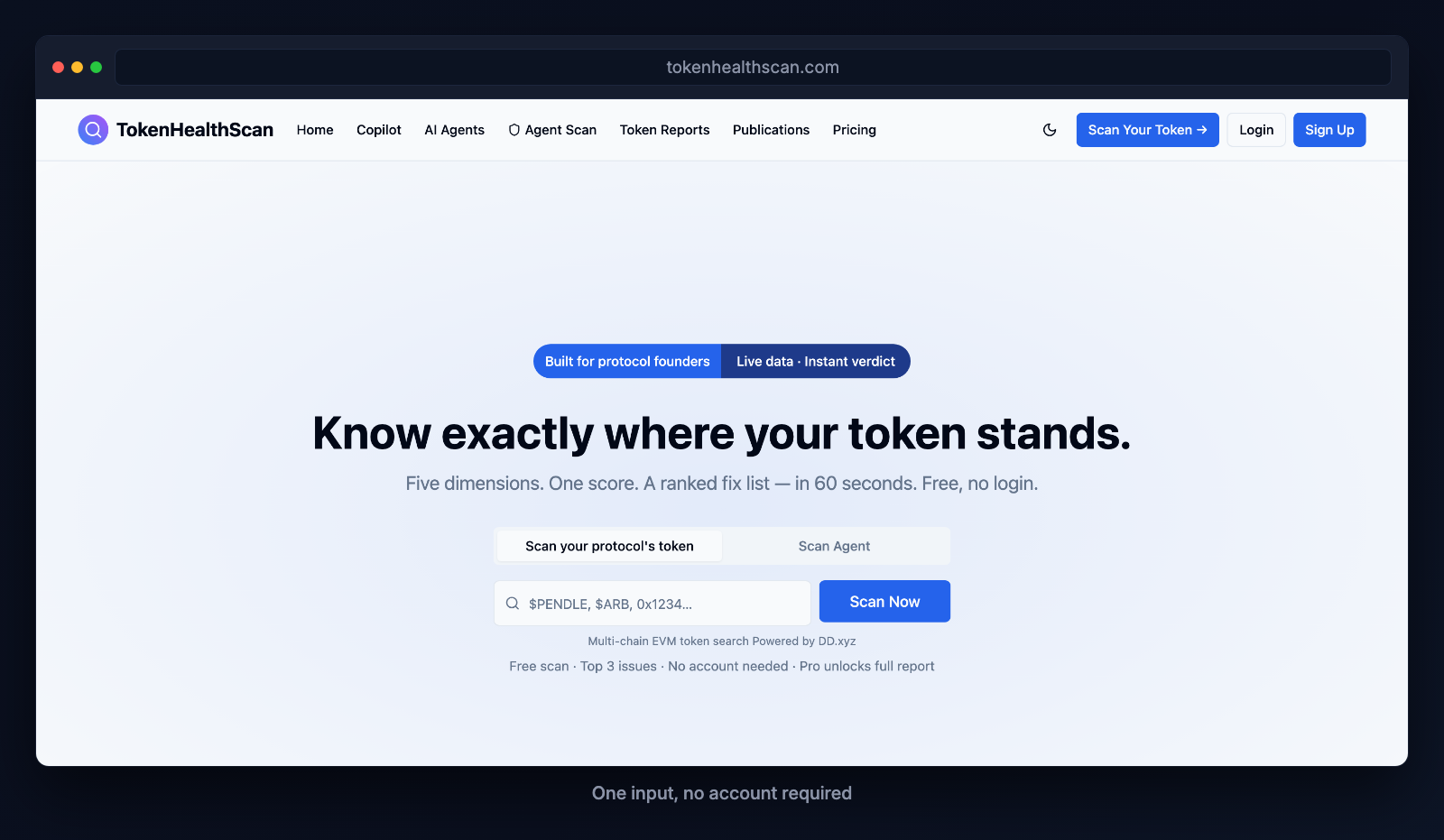
Running a scan takes one input and no account.
The Scanners: Strengths First
Token Sniffer — The Incumbent
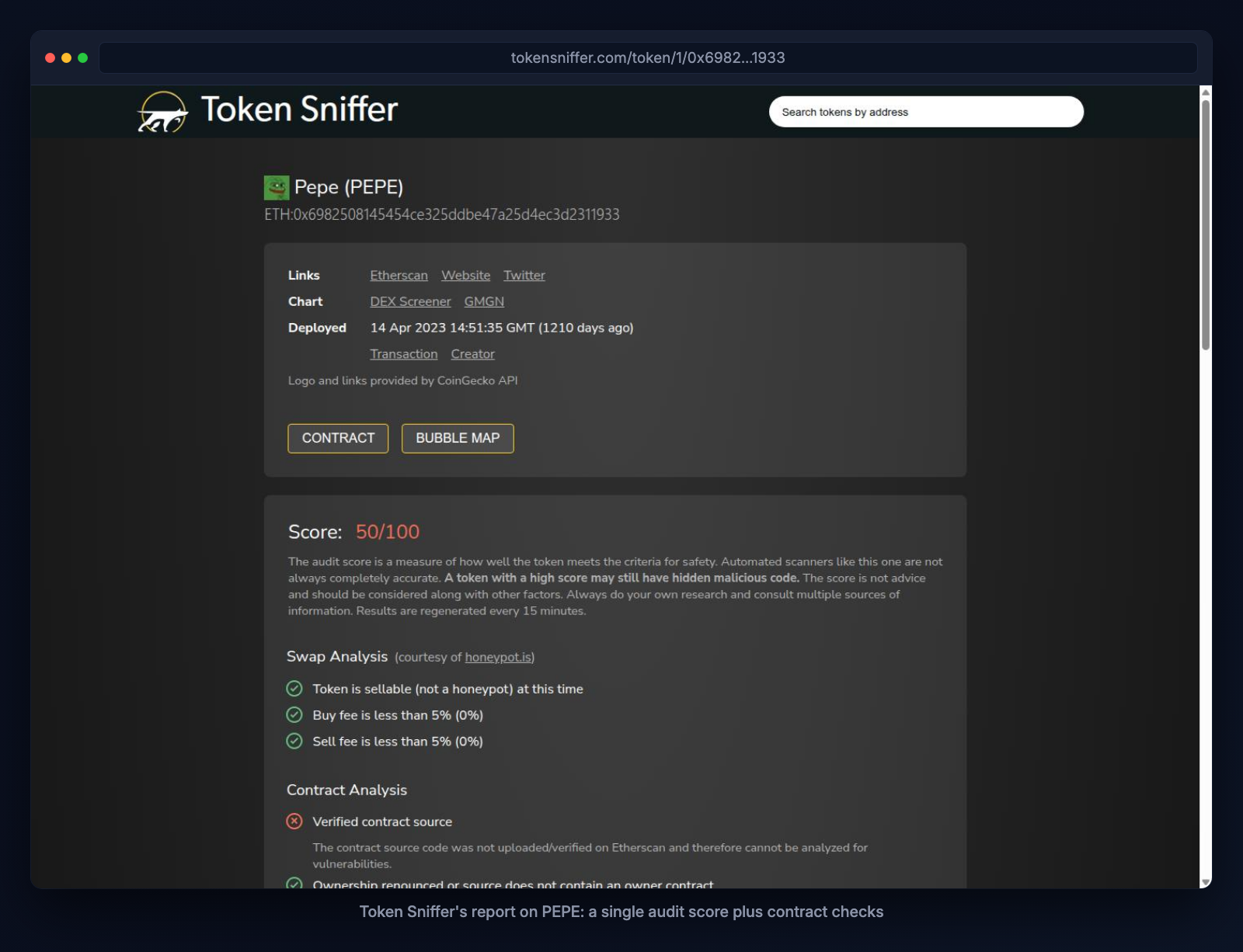
What it does: Automated scam detection. Simulates contract behavior against a database of 55+ million monitored tokens and 7.5+ million flagged scams. The most-cited tool of its kind. Free web app. No login required.
Strengths:
- First-mover advantage and the largest public token-monitoring database in this category.
- Free unlimited web access with no signup friction.
- Backed by Solidus Labs, an institutional trade-surveillance vendor. That pedigree lends credibility most competitors can't match.
- 15-chain support including both EVM and Solana.
Tradeoffs:
- Security detection only. No liquidity depth analysis, tokenomics scoring, community signals, or developer-activity checks. If a token passes TokenSniffer but has 90% whale concentration, you won't know from this tool alone.
- Locker detection is marked "Coming soon" on Optimism, Blast, Gnosis, Harmony, KCC, and Oasis.
Best for: Traders who need a quick security thumbs-up/down before executing. Developers building security-only infrastructure.
If TokenSniffer already cleared your token and you're wondering what to check next, see Token Sniffer Alternatives — it walks through the five gaps a security-only pass leaves open, one tool per gap.
DEXTools — The Trading Terminal
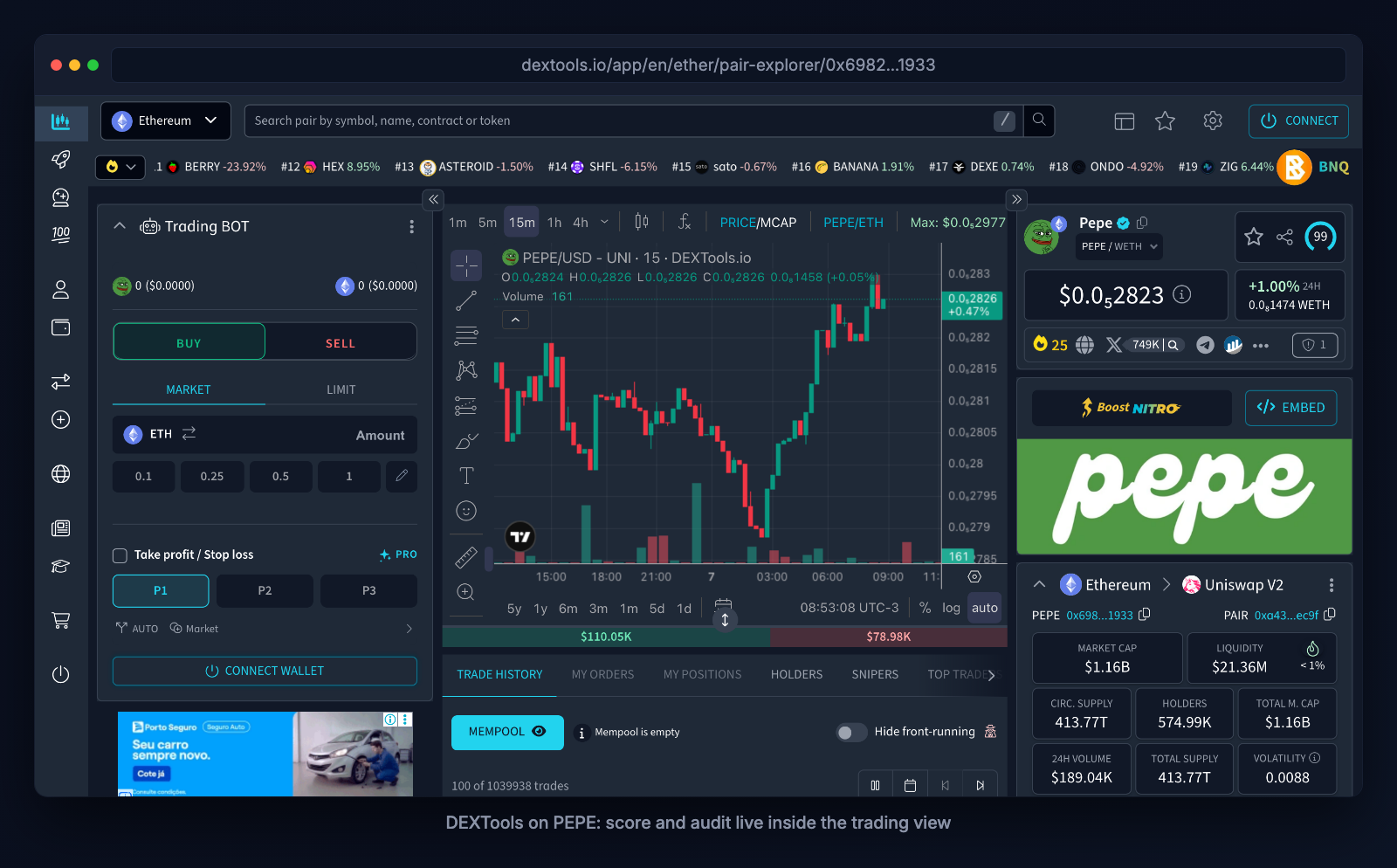
What it does: Real-time DEX trading platform with embedded token scores. Charts, order books, trending pairs, and a "Score" column on every pair. Not a dedicated scanner — security is a secondary feature bolted onto a trading interface.
Strengths:
- Dominant trading terminal by traffic and integration depth. Dexscreener, Jupiter, and other major DEX aggregators embed or reference DEXTools data.
- Real-time liquidity depth and charting that security-only tools can't compete with.
- Free tier fully functional without login.
Tradeoffs:
- Premium tier ($100/mo) is token-gated: you must hold 100,000 DEXT to unlock signals and alerts. That requires acquiring a volatile asset before you can access advanced features. Flat-rate pricing (like Token Health Scan's $20/mo) is simpler.
- The embedded "Score" and "Audit" fields are compressed signals inside a trading UI, not a structured multi-dimension health report. No dimension breakdown or actionable remediation guidance.
Best for: Day traders and technical-analysis-first investors. Teams running live trading bots.
De.Fi Scanner — The Broad-Coverage Specialist
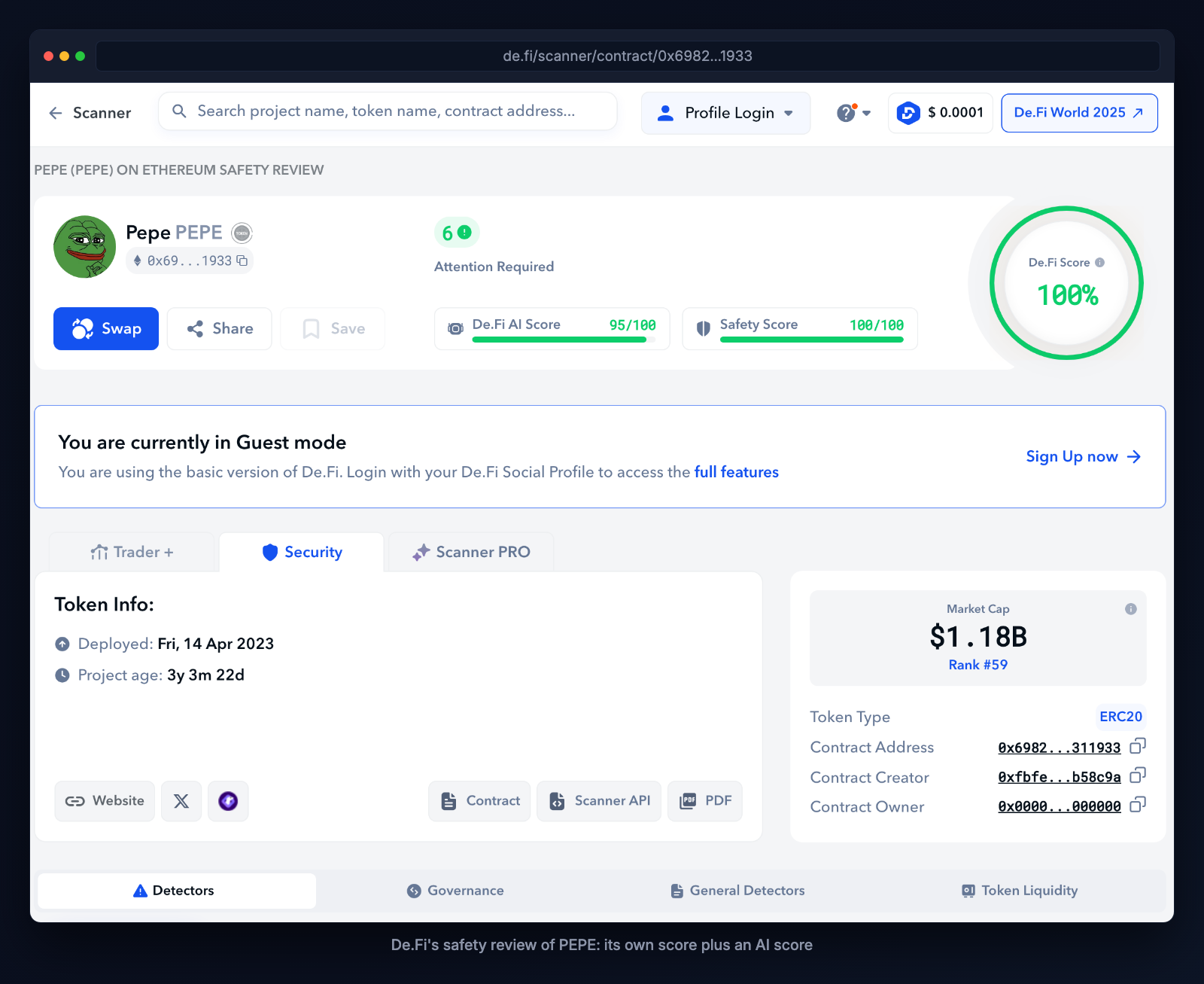
What it does: Contract security analysis producing a proprietary "De.Fi Score," plus wallet-level approval scanning (Shield). Also bundles a historic hack catalogue (REKT Database) and portfolio tracking.
Strengths:
- Broadest self-reported chain support: ~40–45 networks for Shield approval scanning. More chains than THS, GoPlus, and most other tools.
- Only tool combining contract scanning with wallet-approval revocation in one product.
- Non-custodial, read-only: no wallet connection required to paste a public address and view results.
Tradeoffs:
- Pricing for advanced tiers (Scanner PRO with AI dimension scoring) is not publicly listed. The company requires a direct inquiry to quote. That's a friction point vs. published pricing.
- De.Fi's self-reported chain and protocol counts vary across their own materials (40–45 for Shield, 41 for API, 8 named for Scanner). Be skeptical of any "40-chain" claim without verifying which product is actually covered.
- Feature sprawl into yield tracking and portfolio management dilutes the security-scanner focus.
Best for: Teams wanting wallet-approval management (revoke token permissions in one click) alongside contract scanning. Protocols in geographically diverse ecosystems.
GoPlus — The Infrastructure Layer
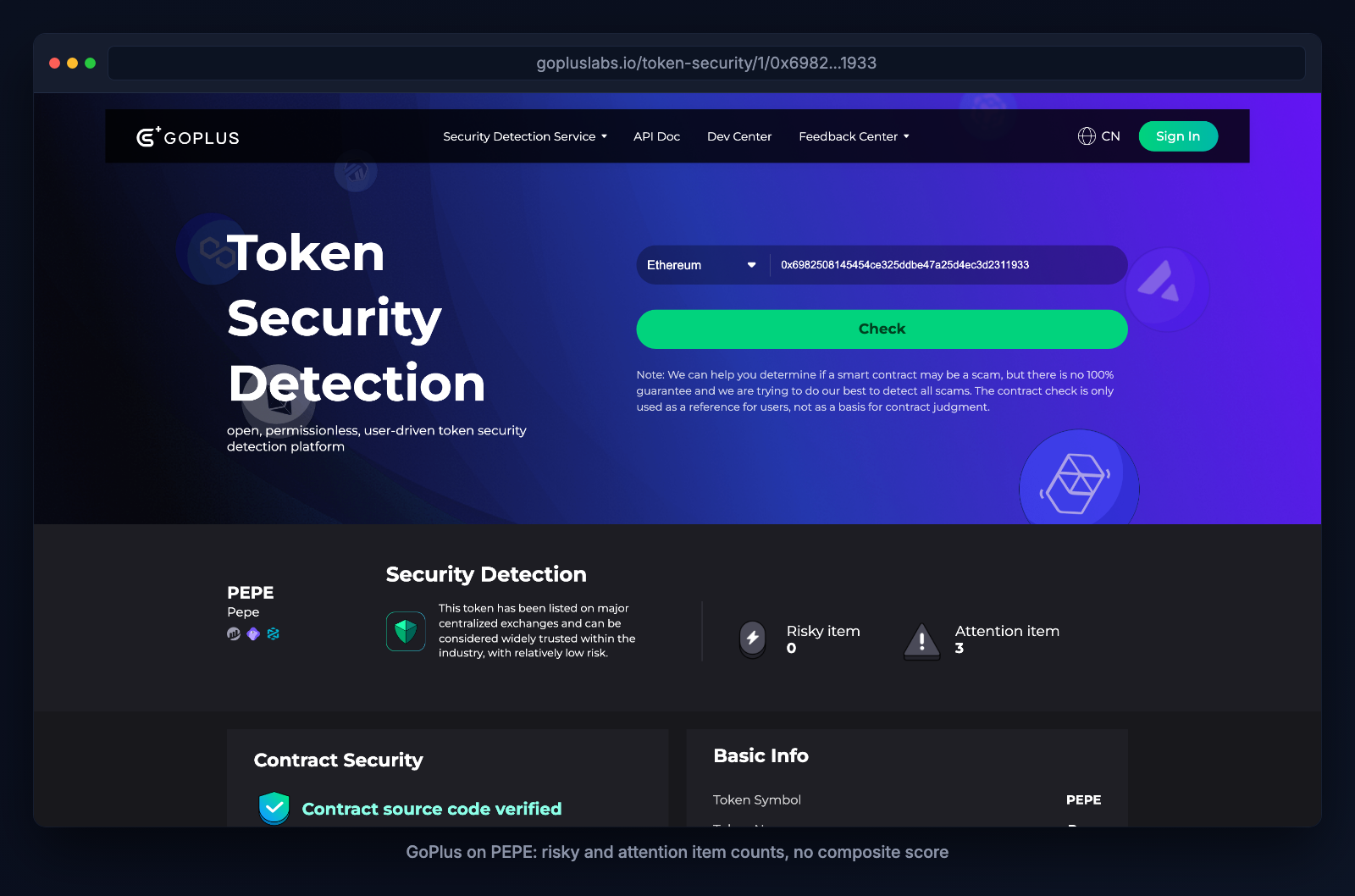
What it does: Decentralized security detection. Core product is Token Security Detection (contract scanning), but the platform also ships AI-agent security (AgentGuard for prompt-injection detection, DeepScan for AI-powered audits), Solana/Sui-specific scanners, and NFT security.
Strengths:
- Widest verified chain support: 40+ EVM chains, plus separate Solana and Sui coverage. Covers Monad, Berachain, Unichain, and other cutting-edge L2s before competitors do.
- API powers DexScreener's security layer and is integrated into OKX. Third-party integrations are trust signals.
- AI-agent security products (AgentGuard, DeepScan) are 2026-era differentiators. No other scanner in this category offers dedicated agent-skill auditing or AI-powered contract review in the same way.
- Free tier includes 150K API Compute Units per month.
Tradeoffs:
- Security detection only. No liquidity, tokenomics, community, or development sub-scoring on the public console (though the API is flexible enough to compose these if your engineering team builds it).
- GoPlus's own disclaimer: "there is no 100% guarantee... the contract check is only used as a reference for users, not as a basis for contract judgment." Narrower liability posture than a comprehensive "health score."
Best for: Multi-chain protocols needing security checks across 40+ networks. AI agent platforms integrating token-risk scoring into agent workflows (via AgentGuard). Teams building security-layer infrastructure.
Honeypot.is — The Specialized Detector
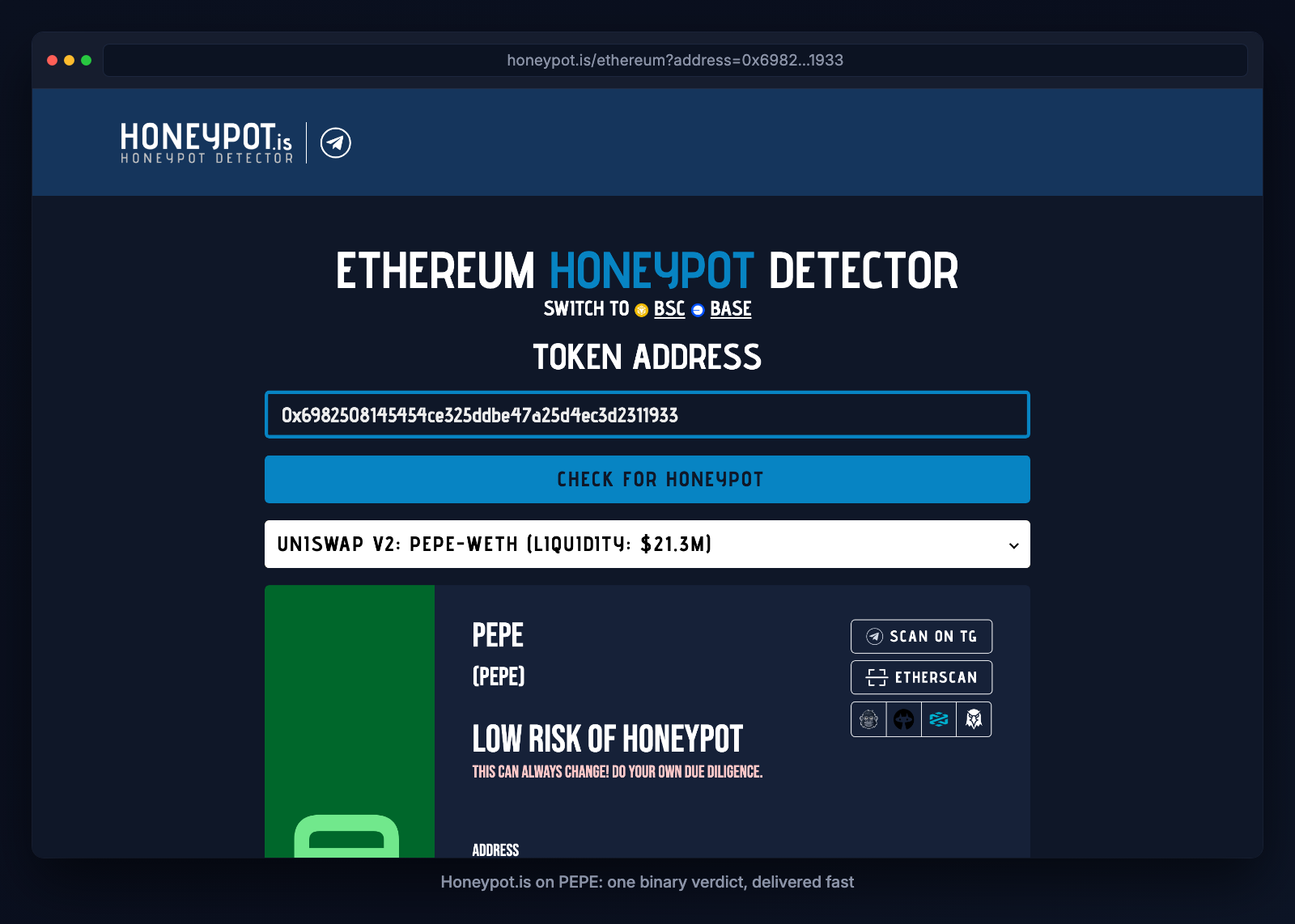
What it does: Single-purpose honeypot detector. Simulates a buy and sell to determine if a contract prevents selling (the honeypot attack pattern). Explicitly narrow scope and honest about it: "This is not a foolproof method."
Strengths:
- Embedded in DEXTools, TokenSniffer, and trading bots as infrastructure. That distribution means Honeypot.is results surface inside tools Ethereum and BSC traders already use.
- Free API with zero authentication required (no API key system yet, just call it).
- Narrow focus means deep expertise. Honeypot detection is one task done well.
Tradeoffs:
- Only 3 chains: Ethereum, BSC, Base. No Solana. If you're scanning Solana tokens, Honeypot.is can't help.
- Premium API tier has been "planned" for a long time but still not available.
- Binary output (honeypot or not honeypot). No composite score, no remediation guidance, no social or developer signals.
Best for: Ethereum/BSC traders doing a single-gate security check before buying. Developers embedding honeypot detection into bots or dashboards.
RugCheck — The Solana Specialist
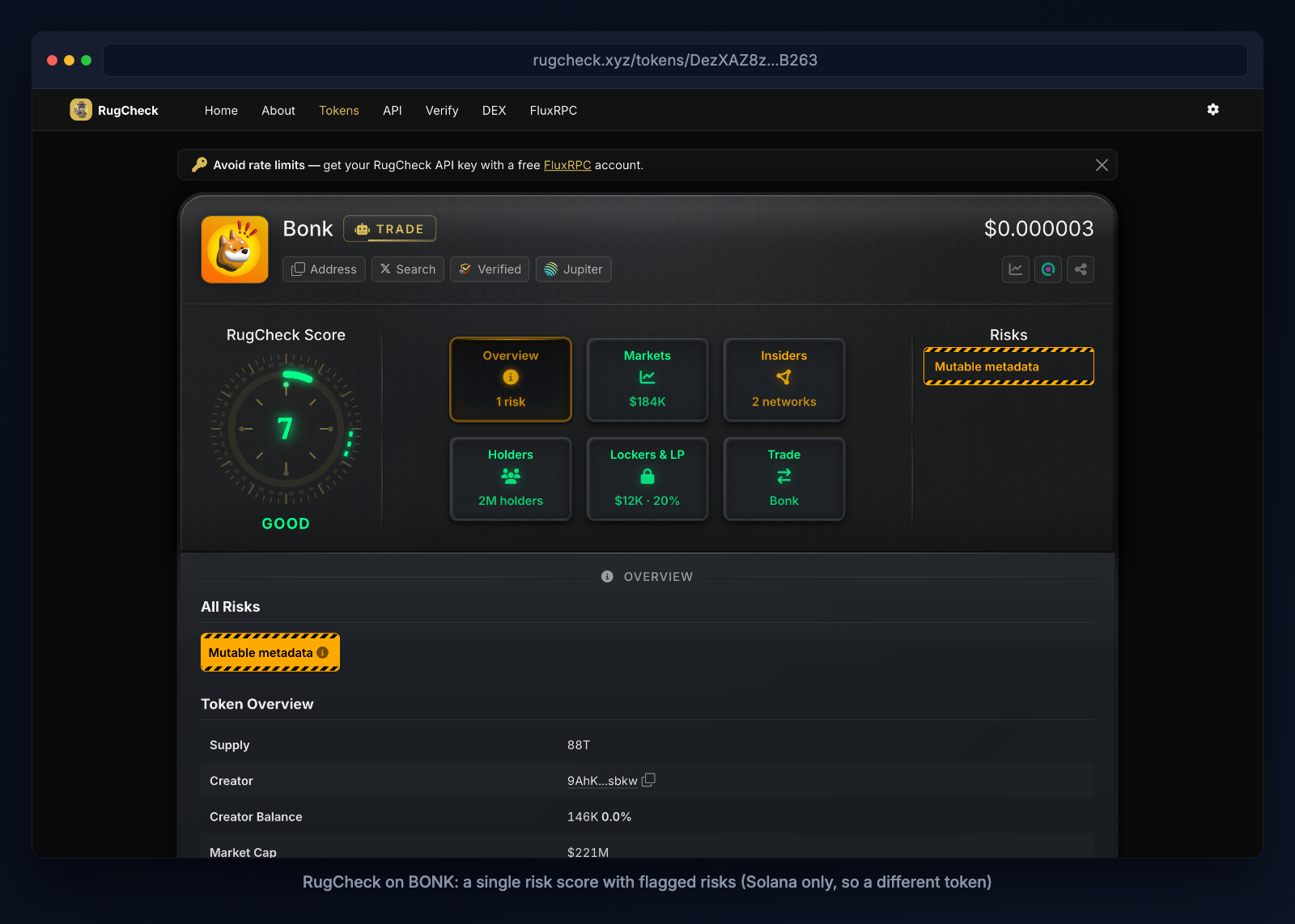
What it does: On-chain risk intelligence for Solana (and newly, Fogo). Bulk-report API (up to 1,000 tokens per request) built for algorithmic trading. Explicit positioning: "RugCheck has no token of its own... our goal is to protect you from rug pulls, period." That neutrality pledge is genuine and worth respecting.
Strengths:
- Deep Solana integration ecosystem. Results surface inside Solscan, Raydium, Streamflow, Dexscreener, Jupiter, GeckoTerminal, CoinMarketCap. Solana traders encounter RugCheck data everywhere.
- No-token-no-conflict positioning is a credibility differentiator. Unlike DEXTools (DEXT-gated Premium), RugCheck has zero financial incentive to bias results.
- Bulk-report API (1,000 tokens in one batch) is designed for scale — AI and algorithmic trading integrations.
- 2026 update: Fogo chain support is the clearest dated product expansion found across all 7 competitors researched.
Tradeoffs:
- Solana and Fogo only. Zero EVM support. If you trade Ethereum or Polygon tokens, RugCheck can't scan them.
- Single risk-score output (no separate tokenomics, community, or development sub-scores visible on public pages).
Best for: Solana-native traders, bots, and launchpad platforms. Teams building Solana-first DeFi apps.
Quick Intel — The Most Affordable
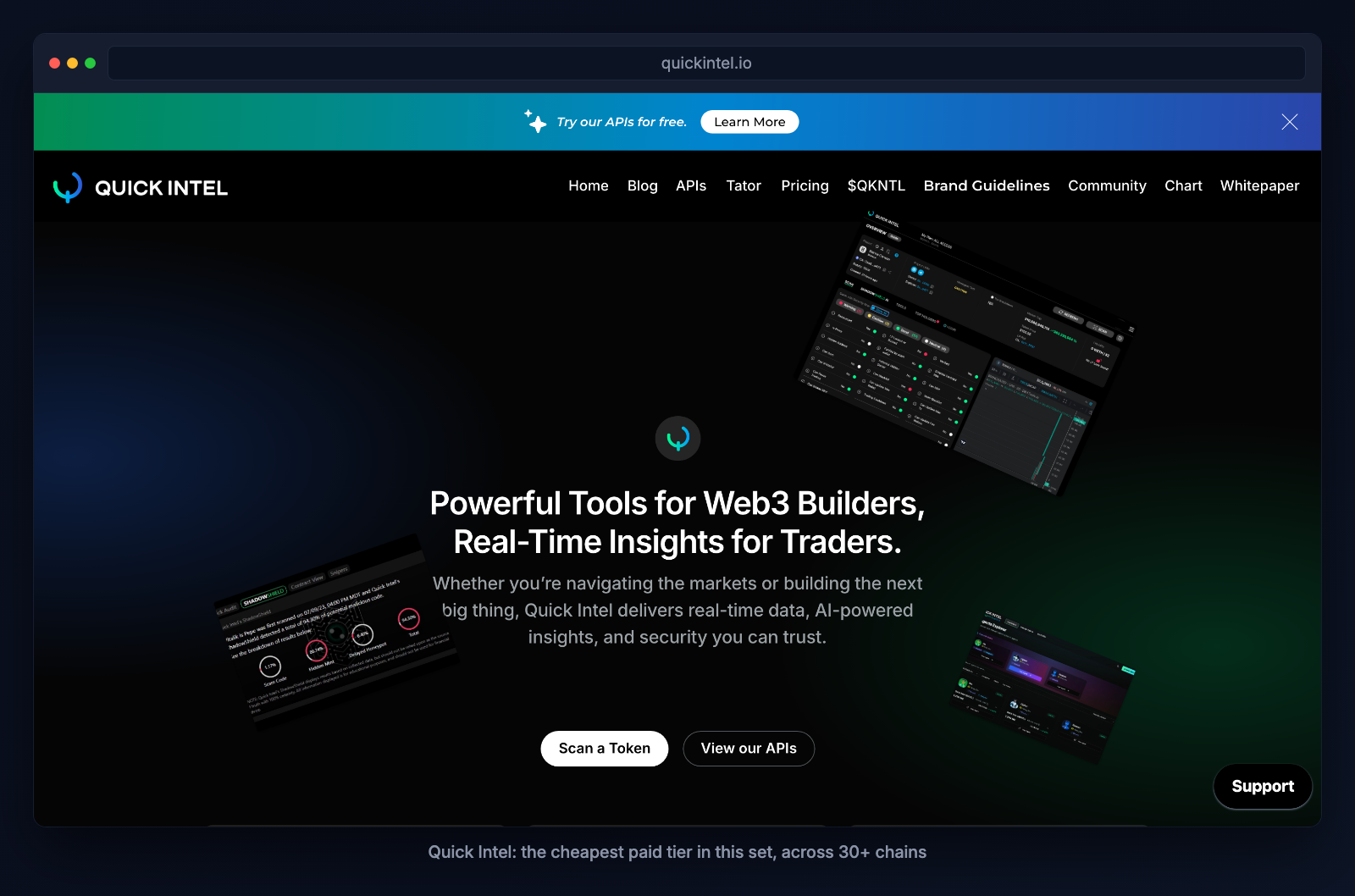
What it does: Smart contract scanner plus broader trading-intelligence app (Tator). Features: contract analysis, snipers/airdrops detection, ShadowShield AI (AI-estimated scam probability as a percentage), honeypot test, contract-reuse detection (flags a contract used across multiple tokens/chains).
Strengths:
- $4.99/mo entry price is the cheapest paid tier of any competitor researched. If you want a paid scanner on a tight budget, Quick Intel wins.
- Contract-reuse detection is a distinct feature. It flags when a contract appears on multiple tokens/chains, a pattern that often signals a low-effort token mill.
- Widest in-app access: web, Telegram bot, Discord bot, iOS, Android. More distribution surfaces than competitors.
- 30+ chains supported (tied with GoPlus for breadth).
Tradeoffs:
- In-app subscription plans ($0, $4.99, $12.99) do not include API access. Developer API pricing is separate (not published in this research, but accessible via developer.quickintel.io).
- Pricing page itself flags two tiers as provisional: "Note: Subject to change as tier is not finalized." Treat current pricing as unstable.
- All Access Pro ($12.99+ tier) is newly listed and token-gated ("Tokens Only"), mirroring DEXTools' model. If you want the top tier, you'll need to acquire a token and hold it.
Best for: Budget-conscious traders wanting multi-chain coverage at low cost. Teams running Telegram or Discord bots needing integrated scanner access. Bulk API use for AI/algorithmic applications.
Token Health Scan — The Composite Audit
What it does: Five-dimension token health score (0–100 composite) plus independent dimension breakdowns (Security, Liquidity, Tokenomics, Community, Development). All five dimensions fire simultaneously on every scan. Output includes a prioritized remediation checklist — not just a score, but specific fixes ranked by impact.
Strengths:
- Only tool combining all five dimensions into one composite score. Most scanners check one thing. Token Health Scan checks them all at once, so you don't need to hunt across five different tools.
- Remediation checklist is unique in this category. A score tells you there's a problem. A checklist tells you what to fix and in what order (ranked by impact on the score).
- AI Agent (ERC-8004) Trust Scoring. Token scanners test tokens. Token Health Scan also scans ERC-8004 AI agents, the first tool to do so. Useful if you're building AI-wallet or agentic-commerce features.
- Free tier: 3 lifetime scans, enough to run basic checks.
Tradeoffs:
- Chain support is narrower than GoPlus (40+ chains), De.Fi Shield (~40–45), or Quick Intel (30+). Token Health Scan covers 5: Ethereum, Base, Arbitrum, Solana, Polygon. If you need BSC, Optimism, or other L2s, you'll need a second tool.
- Community and development scoring rely on social APIs and GitHub. If a token's Telegram is private, or it has no public GitHub, these dimensions may be lower-signal.
- $20/mo is higher than Quick Intel ($4.99), DEXTools ($100 in DEXT), or TokenSniffer API ($99/mo), but lower than GoPlus baseline ($199/mo).
Best for: Protocol founders auditing tokens before campaigns. Growth operators tracking health scores over time (quarterly baseline). Investors wanting a full picture before sizing a position. AI agent developers integrating token-risk checks via API.
We Ran the Same Token Through All of Them
Every screenshot above is the same token, PEPE on Ethereum, scanned in August 2026 (RugCheck is the exception: it is Solana-only, so that one shows BONK). Running one token through the whole set is the fastest way to see that these tools are not interchangeable.
The verdicts do not agree:
| Scanner | Verdict on PEPE |
|---|---|
| Token Sniffer | 50/100 audit score |
| De.Fi | 100% De.Fi Score, 95/100 AI score |
| GoPlus | 0 risky items, 3 attention items |
| Honeypot.is | Low risk of honeypot |
| Token Health Scan | 68/100 composite, Security 100 and Development 25 |
Two of them disagree on a checkable fact, not just a judgment call: Token Sniffer's report marks the contract source as unverified, while GoPlus reports the source code as verified.
None of this means a tool is broken. They are answering different questions on different data, and a "score" from one is not comparable to a "score" from another. That is the practical takeaway: a single number from a single scanner is a starting point, not a conclusion. Run two, understand what each one actually measures, and treat a disagreement as a prompt to look closer rather than a tie to break.
Which Scanner for Which Job?
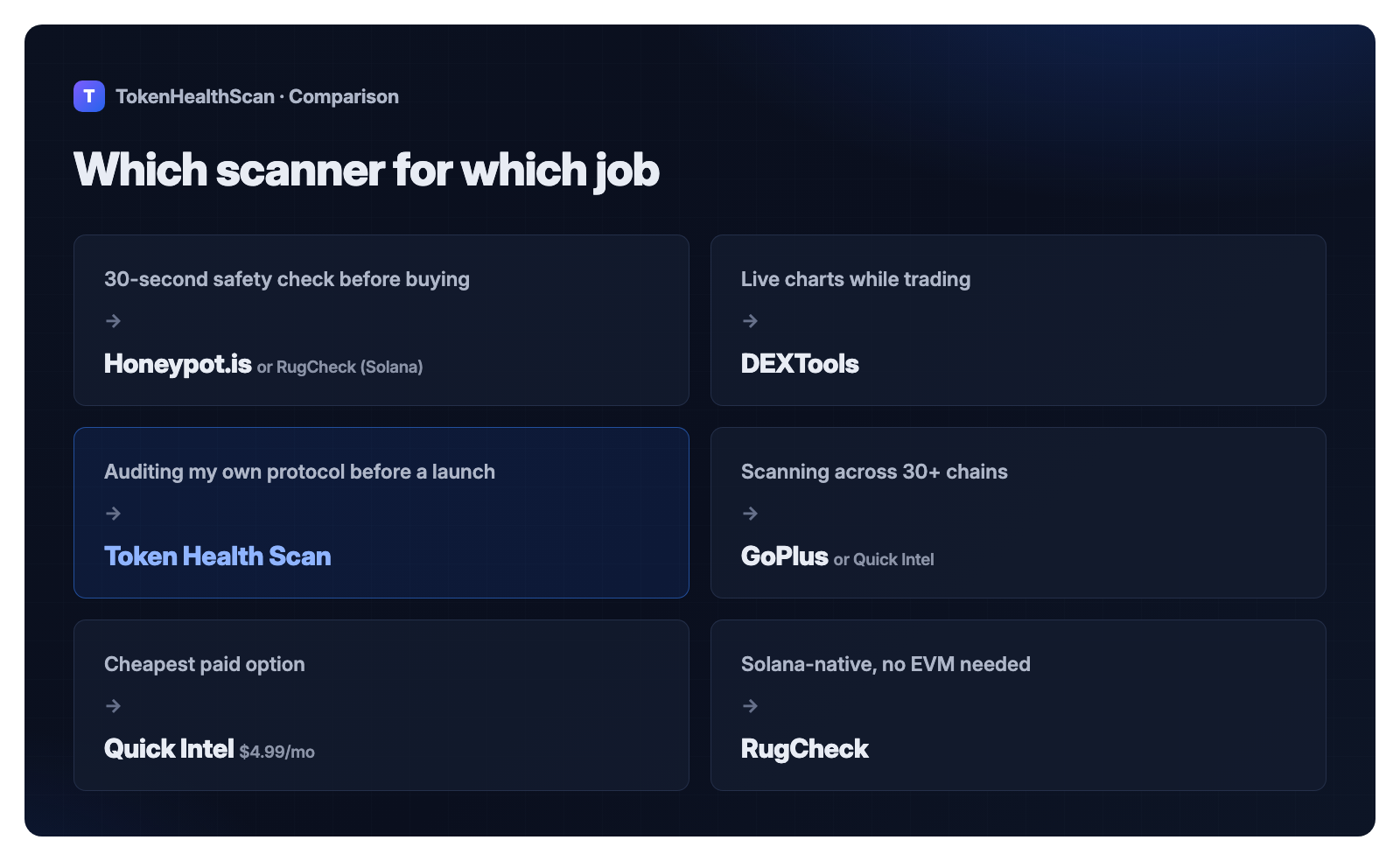
I need a 30-second security check before buying a token.
Use Honeypot.is (Ethereum/BSC) or RugCheck (Solana). Both are free, fast, and widely trusted. TokenSniffer is also good here.
I'm a day trader. I need live charts and quick trust signals.
Use DEXTools. It's the dominant trading terminal. You live in DEXTools anyway; the embedded security signals are a bonus.
I'm a protocol founder launching a campaign or investigating a price decline.
Use Token Health Scan. You need all five dimensions at once, including a fix list. A single security check isn't enough.
I'm building an AI agent or wallet that needs token-risk scoring.
Use Token Health Scan API ($20/mo for unlimited scans) or Quick Intel ($4.99/mo). Both are developer-friendly and fast. GoPlus ($199/mo) is overkill unless you need 40-chain coverage or want their AI-agent security products too.
I need to cover 40+ chains.
Use GoPlus (40+ EVM, Solana, Sui), De.Fi (40–45 for Shield), or Quick Intel (30+ chains). Token Health Scan's 5-chain support is a hard boundary today.
I want the absolute cheapest paid option.
Use Quick Intel ($4.99/mo). TokenSniffer API is $99/mo (security only), so Quick Intel wins on price.
I'm a Solana-native team and don't care about EVM.
Use RugCheck (free API, Solana + Fogo). No other tool has the Solana integration depth RugCheck does.
Frequently Asked Questions
Does every scanner flag the same risks?
No. TokenSniffer might flag a contract as clean while RugCheck scores it as medium-risk (because they check different signal sets). Always run a token through 2–3 scanners before deciding. Token Health Scan's 5-dimension approach means you run fewer tools to get a comprehensive picture, but it's still good practice to cross-check with a security-only tool like TokenSniffer on highly risky tokens.
Can I use a free scanner and skip paid tiers?
Yes, if you're doing basic due diligence. TokenSniffer free, Honeypot.is free, RugCheck free ($0/mo, 3 requests/sec), Quick Intel Basic ($0/mo) are all legitimate free-tier options. The tradeoff is limited rate-limits and no historical tracking. For quarterly tracking or bulk scans, a paid tier adds value.
What's the difference between "Score" and "Health Score"?
Most scanners (TokenSniffer, DEXTools, GoPlus, RugCheck) return a binary judgment (scam or not) or a single-dimension score (security only). Token Health Scan returns a health score across five dimensions. The health score is more like a medical exam; a single security score is more like a blood-type check. Related but different in scope.
Can I embed a scanner API into my dashboard or bot?
Yes, almost all scanners here offer APIs: TokenSniffer ($99/mo), DEXTools (DEXT-gated), GoPlus ($199/mo), Honeypot.is (free, no auth), RugCheck ($40/mo base), Quick Intel (separate API pricing), Token Health Scan ($20/mo). API pricing and rate-limits vary widely. Check the developers section of each tool before committing.
Which scanner catches the most scams?
TokenSniffer's database (55+ million monitored tokens) is the largest of any tool researched. But "most scams caught" depends on your definition. A honeypot detector catches one type of scam; a security scanner catches contract exploits; a tokenomics audit catches distribution rug pulls. No single tool catches all types.
Is one free scan per day really all I need?
It depends on how often you trade. If you're testing a new token weekly, yes. If you're researching dozens of tokens per week or building a live-updating dashboard, you'll need a paid tier.
Explore the Cluster
- The State of Token Health — Aggregate data across every token we track: dimension averages, the full ranked list, and the trend since 2025. Updated quarterly.
- Token Sniffer Alternatives (2026) — What to run after TokenSniffer clears a token.
- DEXTools vs Token Health Scan — Different jobs, honestly explained.
- RugCheck vs Token Health Scan (Solana) — Solana-native comparison.
- GoPlus vs Token Health Scan — Infrastructure-grade security API vs. five-dimension audit.
- De.Fi vs Token Health Scan — Wallet-approval management vs. token-level audit.
- Quick Intel vs Token Health Scan — Cheapest multi-chain option vs. remediation depth.
- Honeypot.is vs Token Health Scan — A single-purpose free gate vs. a full health picture.
- Token Scan Guide: How to Use a Token Scanner — The signals to look for on every scan.
See the Output for Yourself
These reports re-scan daily, so the numbers move. What stays constant is the shape of the output: five dimensions, scored independently, and a composite that can hide as much as it reveals.
- PEPE (Ethereum) — Contract security scores at the top of the range while development activity sits near the bottom. A security-only scanner shows you the first signal and none of the second.
- JUP (Solana) — Strong security and tokenomics, softer community and development. The spread between dimensions is the story, not the headline number.
- OKB (Ethereum) — An exchange token with a clean contract whose composite is pulled down by community and development signals.
References
- TokenSniffer — https://tokensniffer.com
- DEXTools — https://www.dextools.io
- De.Fi — https://de.fi
- GoPlus — https://gopluslabs.io
- Honeypot.is — https://honeypot.is
- RugCheck — https://rugcheck.xyz
- Quick Intel — https://quickintel.io
- Token Health Scan — https://tokenhealthscan.com
*Data verified from live product pages and API documentation as of August 6, 2026. Pricing and chain support subject to change.*