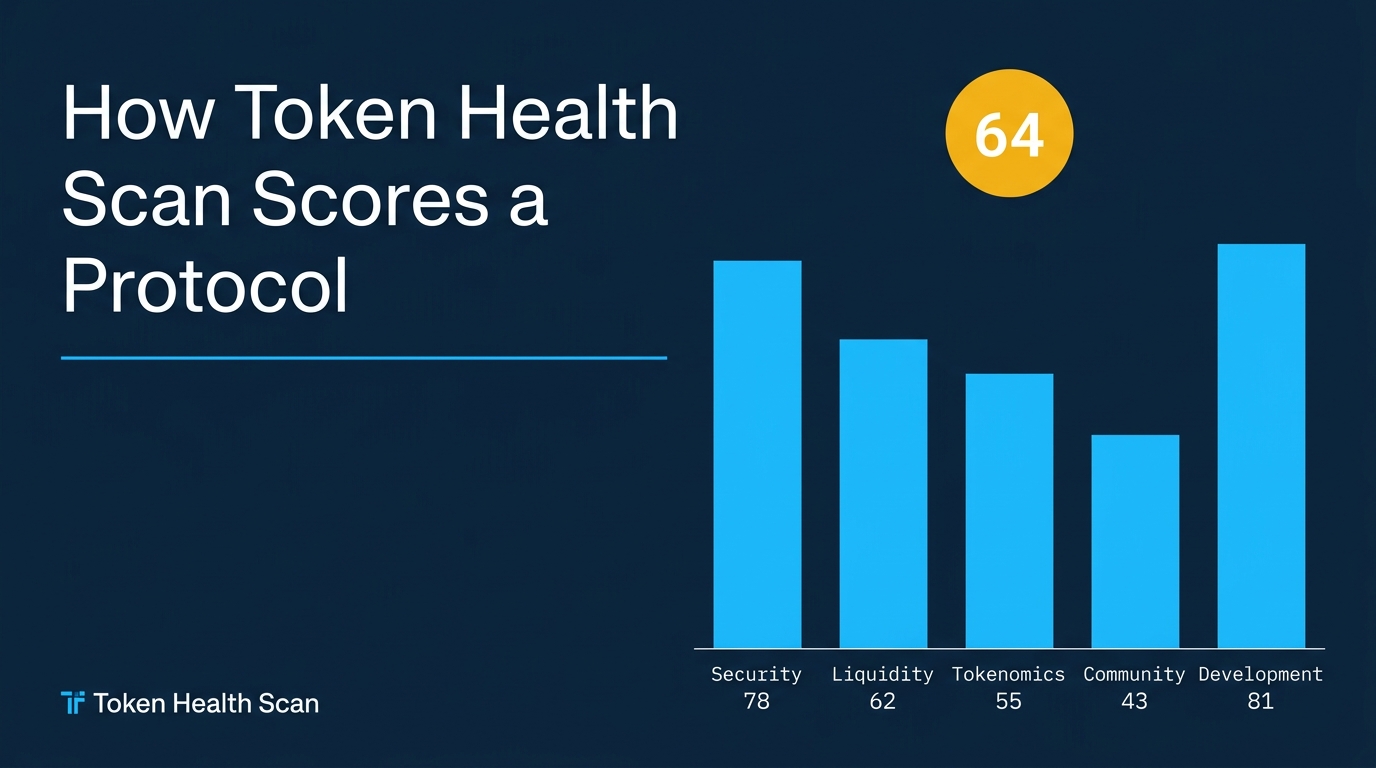
You get a number between 0 and 100.
That number represents the health of a DeFi protocol across five independent dimensions of on-chain and off-chain data. It is not a sentiment score. It is not a community rating. It is a data audit. The same checks a technical investor would run manually, collapsed into a single output.
What the color bands mean:
| Score | Status | Interpretation |
|---|---|---|
| 70–100 | Green / Healthy | No critical flags. Normal monitoring cadence. |
| 40–69 | Gold / At-Risk | One or more dimensions showing active risk signals. Review remediation checklist. |
| 0–39 | Red / Critical | Critical flags present. Immediate review required. |
Q: What does a Token Health Scan score represent?
A: A composite 0–100 score based on five independently-scored dimensions: Security, Liquidity, Tokenomics, Community, and Development. Each dimension uses live on-chain and off-chain data. The overall score is the arithmetic mean of all five.
Five Dimensions. Each One Catches a Different Failure Mode.
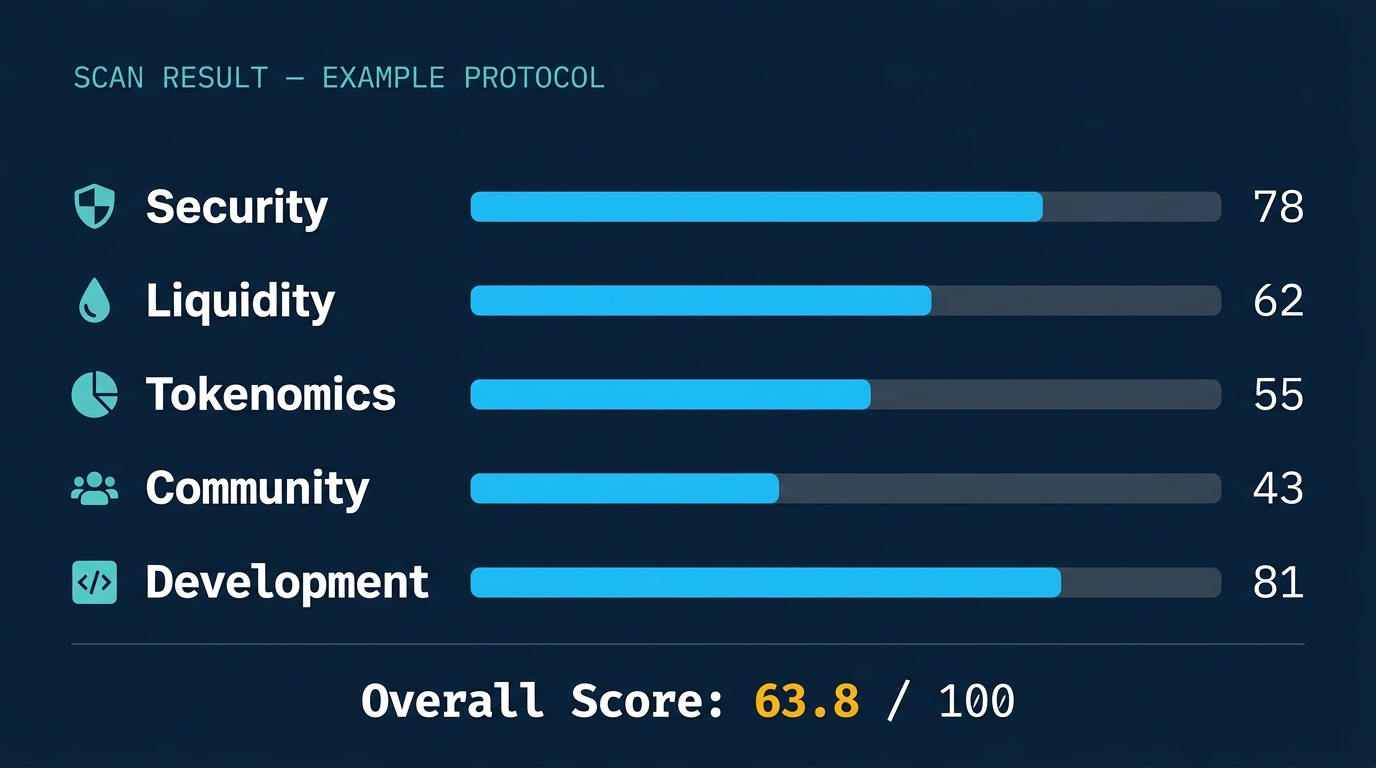
Example scan result — five dimension scores with overall score 63.8/100
Most token analysis tools check one thing. Token Sniffer checks for honeypots. LunarCrush tracks social sentiment. Nansen tracks wallet flows. Each is useful in isolation.
The problem is failure mode diversity. A protocol can pass a security audit and still collapse from a single large LP unlock. A protocol can have perfect tokenomics on paper and a development team that stopped committing code 6 months ago.
THS scores all five in a single scan.
| Dimension | What it catches | Primary data sources |
|---|---|---|
| Security | Contract exploits, hidden mint risk, ownership backdoors | GoPlus Labs, Webacy |
| Liquidity | Pool rug vectors, thin markets, whale LP concentration | Moralis, GeckoTerminal, DefiLlama |
| Tokenomics | Holder concentration, unlock cliffs, mint authority | Moralis, Helius (Solana) |
| Community | Bot-inflated engagement, declining holder count, dead channels | LunarCrush, Apify, Discord API |
| Development | Stalled codebases, missing audits, single-contributor risk | GitHub API |
Each dimension scores independently, 0 to 100. A protocol can have a 92 in Security and a 14 in Community. The overall score is the arithmetic mean. No single dimension is artificially weighted above the others in the final number.
Security: Catching Contract Risk Before It Becomes a Crisis
Q: How does Token Health Scan score token security?
A: THS pulls live data from GoPlus Labs and Webacy to check for honeypot flags, mint function risks, ownership centralization, and malicious function patterns. Each signal is weighted and combined into a 0–100 security score.
What THS measures
Honeypot detection. GoPlus queries the contract for transfer restriction patterns that would prevent token holders from selling. This is the most common rug-pull vector in DeFi.
Mint function flags. Does the contract deployer retain the ability to create new tokens? An unchecked mint function means the circulating supply can be inflated at will. THS flags this with the severity of the current mint authority state.
Ownership centralization. Has ownership been renounced? If control is retained, who holds it? Concentrated ownership with admin function access is a single point of failure.
Malicious function patterns. Proxy upgrades without timelocks, hidden transfer taxes, blacklist functions that can freeze wallets. GoPlus identifies these against a database of known malicious contract patterns.
Data sources
GoPlus Labs provides the primary security layer, authenticated via HMAC-SHA1 with a 1-hour response cache. Webacy provides supplemental risk flags for EVM chains (Ethereum, Polygon, BSC, Arbitrum, Base, Optimism). Solana scans use GoPlus only. Webacy does not cover Solana.
What a low Security score means
A security score below 40 means at least one critical flag is active. Common failure states include: an active honeypot flag, a deployer-held mint privilege with no governance lock, or a proxy upgrade mechanism with no timelock delay. These are not theoretical risks. They are live code states that have triggered losses in real protocols.
Liquidity: Spotting the Rug Before the LP Unlocks
Q: How does Token Health Scan measure token liquidity?
A: THS analyzes pool depth relative to FDV, LP lock status, slippage at standard trade sizes, and whale LP concentration using Moralis and GeckoTerminal data. The liquidity score reflects how easily a large holder or LP could exit without crashing the price.
What THS measures
Pool depth vs. FDV ratio. A protocol with $50M in fully diluted valuation and $200K in DEX liquidity has an exit liquidity problem. Any meaningful sell order moves the price. THS scores this ratio against benchmarks for the protocol's market cap tier.
LP lock status. Are the primary liquidity providers locked? Unlocked LP is a direct rug-pull vector. THS checks lock duration and percentage of total pool depth that is currently locked.
Slippage at standard trade sizes. THS models slippage at representative trade sizes to quantify actual exit friction for different holder sizes.
Whale LP concentration. What percentage of total pool depth is held by the top 10 LPs? High concentration in a small number of LPs means a single exit decision can drain pool depth.
DEX volume trend. 7-day and 30-day volume trends signal whether market activity is growing or deteriorating.
Data sources
Moralis provides token pair data, market statistics, and token metadata. GeckoTerminal provides DEX pool data including volume, liquidity, and pair age for both EVM chains and Solana. DefiLlama provides TVL for protocols in its tracked set.
A note on DefiLlama coverage: At the current version, TVL data is available for 11 major protocols including Aave, Uniswap, Curve, Sushiswap, and Yearn. Tokens outside this set use pool depth, slippage, and volume data for their liquidity score. Expanding DefiLlama coverage is in the active backlog.
What a low Liquidity score means
A liquidity score below 40 typically means thin pool depth relative to market cap, significant unlocked LP, or a sharp 30-day decline in DEX volume. Any one of these is a caution signal. All three together is a critical flag.
Tokenomics: Seeing the Dump Before the Cliff Hits
Q: What tokenomics signals does Token Health Scan analyze?
A: THS computes a Gini coefficient from top-100 holder data, checks upcoming unlock events and vesting cliffs, identifies mint authority status, and measures top-wallet concentration as a percentage of circulating supply.
What THS measures
Holder concentration (Gini coefficient). THS pulls top-100 holder data via Moralis and computes a Gini coefficient server-side. A Gini of 0.0 means perfect distribution. A Gini of 1.0 means a single wallet holds the entire supply. A high Gini coefficient, typically above 0.85, triggers a concentration flag in the scoring logic.
Upcoming unlock events. Vesting cliffs and team/investor unlock windows are a predictable source of sell pressure. THS identifies scheduled unlock events and weights them by size relative to current circulating supply.
Mint authority status. On Solana, the SPL mint authority indicates whether new tokens can still be created. On EVM chains, this maps to the mint function flag checked in the Security dimension. Both feed into the tokenomics risk model.
Top-wallet concentration. What percentage of circulating supply do the top 5 and top 10 wallets hold? This is distinct from the Gini coefficient. It isolates extreme concentration at the top of the distribution.
Data sources
Moralis provides token metadata, holder statistics, and top-100 wallet data for EVM chains. The Gini coefficient is computed server-side from this holder distribution. For Solana, the Helius DAS API handles token metadata and SPL mint authority data.
What a low Tokenomics score means
A tokenomics score below 40 typically involves a combination of: top 10 wallets holding more than 60% of supply, an active mint authority, or a major unlock event in the next 90 days. Each of these is a separate signal. The remediation checklist will identify which is driving the score.
Community: Separating Organic Hold from Manufactured Hype
Q: How does Token Health Scan score community health?
A: THS pulls social engagement data from LunarCrush, member counts from Telegram and Discord, and follower counts from Twitter/X via Apify. It then checks engagement-to-follower ratios for bot activity patterns. Community is the only dimension that starts at 0. A protocol must earn every point here.
What THS measures
Social engagement score. LunarCrush provides a galaxy score and social dominance metric. These feed directly into the community dimension score.
Holder growth rate. Is the holder count growing or declining over the last 30 days? A declining holder base is often the first visible signal of distribution failure.
Telegram member count. THS scrapes the public t.me page via Apify to pull current member count.
Discord member count. The Discord public invite API returns member count without authentication.
Twitter/X follower count. Pulled via Apify's Twitter actor. Used primarily for the engagement-to-follower ratio calculation.
Bot activity detection. LunarCrush engagement-to-follower ratio anomalies flag accounts where social volume is disproportionately high relative to genuine engagement patterns.
Why Community starts at 0
Security, Liquidity, Tokenomics, and Development all have point baselines in the raw scoring logic. Community does not. A protocol with no social presence earns zero points in this dimension by default. Community health must be demonstrated through actual signals. There is no partial credit for existing.
What a low Community score means
A community score below 40 typically reflects declining holder count over 30 days, engagement-to-follower ratios suggesting bot activity, or absence of active Telegram and Discord channels.
Development: Separating Shipping Teams from Whitepaper Projects
Q: How does Token Health Scan evaluate protocol development activity?
A: THS queries the GitHub API for commit frequency, active contributor count, open/closed issue ratio, and audit history. Protocols with no public GitHub presence score 0 in this dimension. Absence of verifiable development activity is itself a risk signal.
What THS measures
Commit frequency. THS measures commits over rolling 30-day and 90-day windows. A protocol with zero commits in 90 days has no visible development activity.
Active contributors. How many unique committers have pushed code in the last 90 days? A codebase maintained by a single contributor is a single point of failure for protocol continuity.
Code quality signals. The ratio of open to closed issues and pull request merge velocity are proxies for whether the team is actively maintaining the codebase.
Stars and forks trend. Developer ecosystem interest, measured by how the repo's stars and forks are trending over the last 90 days.
Audit history. Has the protocol's codebase been audited by a recognized security firm? THS checks for audit report links in the repo README or linked documentation.
What a low Development score means
A development score below 40 typically indicates: last public commit 90+ days ago, one active contributor, no external security audit, or no public code repository. A combination of all four represents a protocol with no verifiable development accountability.
After the Score: What to Do with It
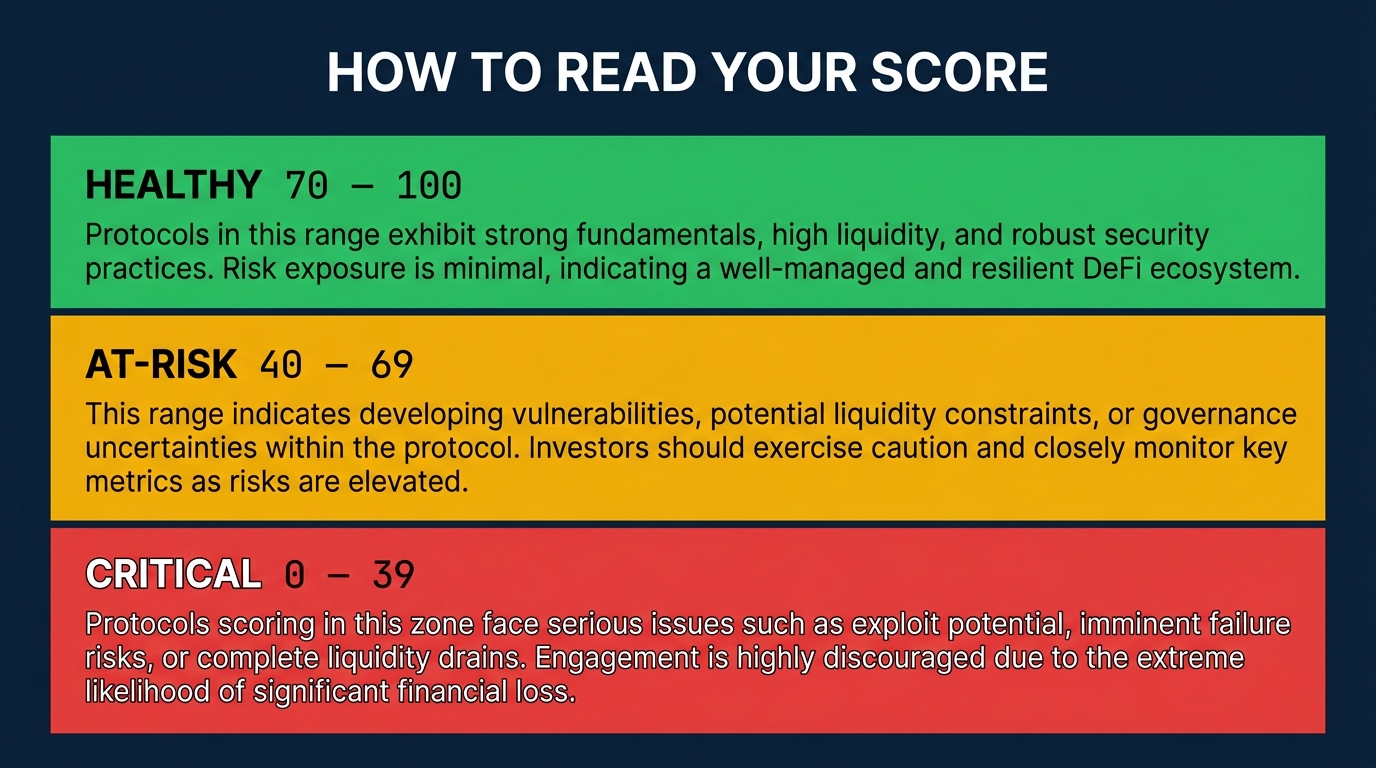
Green (70–100 Healthy), Gold (40–69 At-Risk), Red (0–39 Critical)
The score is the diagnosis. The remediation checklist is the treatment plan.
Every THS scan produces a prioritized checklist alongside the score. Items are ordered by score impact. One override rule applies: Security flags (honeypot, mint risk, proxy upgrade without timelock) are always P1, regardless of dimension weighting.
| Priority | Trigger | Example |
|---|---|---|
| P1 (Critical) | Active security flag or score below 40 in any dimension | Active honeypot flag, LP fully unlocked |
| P2 (Important) | Dimension improvement would move overall score 5+ points | Gini above 0.85, zero audit history |
| P3 (Maintenance) | Small improvements that address signal gaps | Discord invite link missing, GitHub key not configured |
Supported Chains
THS scans tokens on seven chains: Ethereum, BSC, Polygon, Arbitrum, Base, Optimism, and Solana.
| Chain | Scoring path | Webacy coverage |
|---|---|---|
| Ethereum | EVM (GoPlus + Moralis + GeckoTerminal + GitHub) | Yes |
| BSC | EVM | Yes |
| Polygon | EVM | Yes |
| Arbitrum | EVM | Yes |
| Base | EVM | Yes |
| Optimism | EVM | Yes |
| Solana | Helius DAS API + GeckoTerminal + CoinGecko | No |
Run a Free Scan
Every scan produces a complete score with dimension breakdown and remediation checklist.
Free tier: 3 full scans with complete dimension data. No Pro subscription required.
Pro tier: Unlimited scans, historical tracking, score alerts, and bulk scan capability.
Scan Your TokenIf your protocol is scoring below 70 on any dimension, the checklist tells you where to start.